Two of the most capable AI coding tools right now take almost opposite approaches to the same problem: how do you let an AI write production code without making a mess of your codebase?
Kiro (AWS, evolved from Amazon Q Developer CLI) thinks the problem is that AI moves too fast. Skip the spec and you accumulate debt that no amount of future AI can clean up. Claude Code (Anthropic) thinks the opposite: fast iteration with human control beats ceremony every time.
Both make sense. They're just solving different problems.
What Each Tool Actually Does


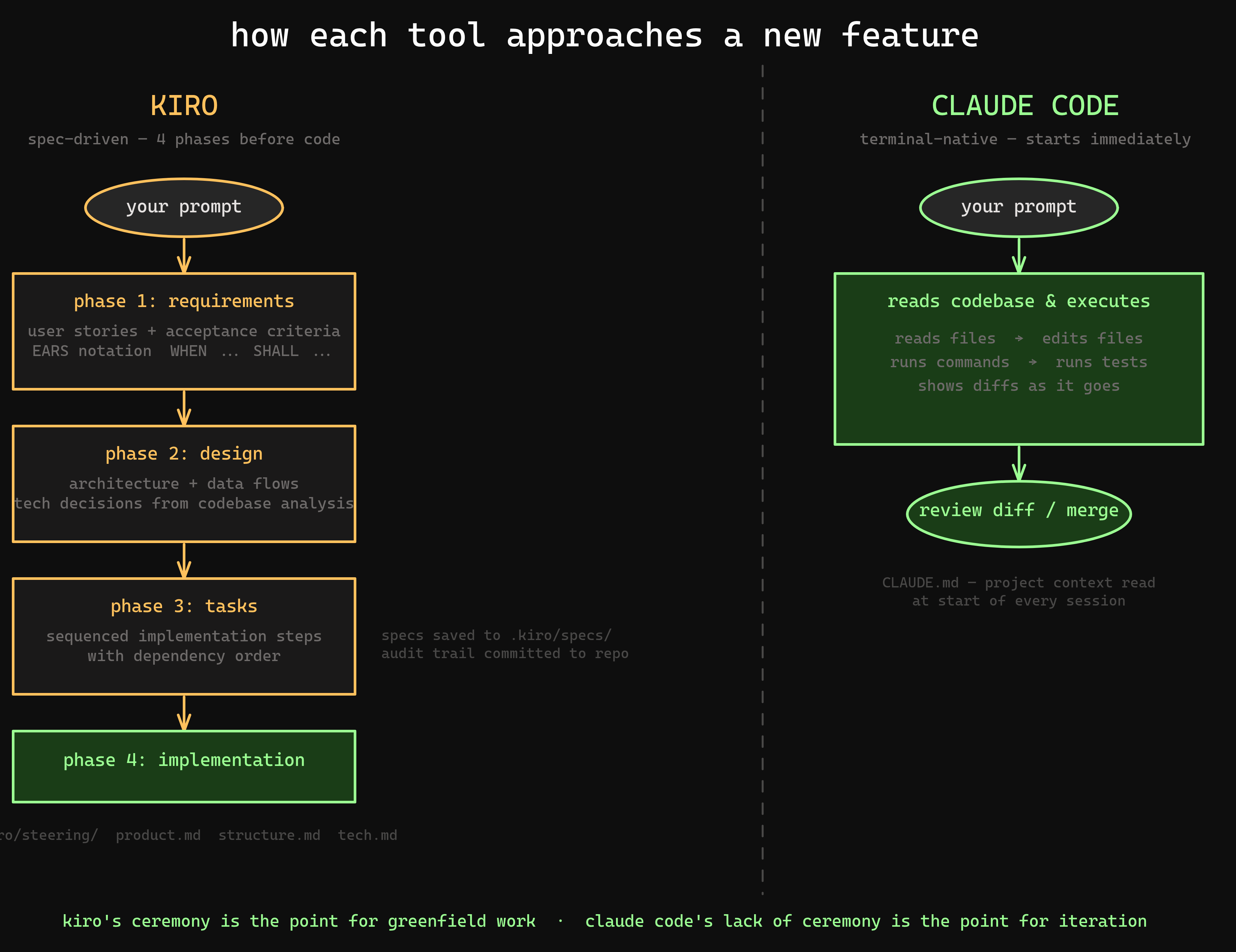
Kiro CLI runs a four-phase workflow before touching your code:
- Requirements: turns your prompt into user stories with acceptance criteria in EARS notation (structured "WHEN ... THE SYSTEM SHALL ..." statements)
- Design: analyzes your codebase and generates architecture, data flows, and tech decisions
- Tasks: breaks the design into sequenced implementation steps with dependency order
- Implementation: writes the code, with optional autopilot mode for autonomous execution
The persistent context layer is called steering files. These are markdown documents in .kiro/steering/ (project-level) or ~/.kiro/steering/ (global). A default Kiro project generates three of them: product.md, structure.md, and tech.md. You can add your own, like a specs.md that tells Kiro to always write tests first.
Claude Code starts writing when you ask. No pre-flight required. You describe what you want, the agent reads your codebase, edits files, runs commands, and shows you the diff. The equivalent of steering files is CLAUDE.md, a markdown file in your project root that Claude reads at the start of every session. It also builds auto memory as it works, saving build commands, debug insights, and conventions without you writing anything.
Kiro is an IDE (VS Code-based) with a CLI component. Claude Code is a CLI tool first, with IDE plugins as a secondary surface. That shapes everything about how they fit into your workflow.
Where Kiro Has the Edge
Multi-model flexibility. Kiro supports Claude, DeepSeek, MiniMax, and Qwen, and lets you pick per task or set Auto. Qwen3 Coder Next costs 0.05x the credits of Claude, so you can stretch a $20/month subscription across far more interactions for documentation or boilerplate work. Claude Code is Claude-only.
Free tier. Kiro gives you 50 credits per month plus 500 bonus credits on signup. Enough to actually try it before paying. Claude Code needs a paid subscription for anything meaningful.
Audit trail. When a feature breaks three months after shipping, Kiro has a paper trail: the original requirements, the design decisions, the task breakdown, all committed to the repo under .kiro/specs. Claude Code generates none of that unless you explicitly ask.
AWS integration. Kiro has IAM Policy Autopilot built in. It can analyze your code and generate appropriately scoped IAM policies. Not relevant outside AWS, but if you're on AWS it's genuinely useful.
Modular context. Kiro's multi-file steering scales better for teams where different roles own different context files. A single CLAUDE.md works well but gets unwieldy on complex projects.
Built-in web search and AWS tooling. Kiro ships web_search, web_fetch, and aws as native built-in tools. No MCP server needed to search the web or make AWS CLI calls during a session. Claude Code can do the same via MCP, but that requires separate setup.
Where Claude Code Has the Edge
Benchmark performance. Claude Opus 4.6 scores 80.8% on SWE-bench Verified, averaged over 25 trials. That puts it on par with Gemini 3.1 Pro (80.6%) and among the highest published scores for real-world GitHub issue resolution. Kiro has published no equivalent data for any model it supports.
Native CI/CD. Claude Code ships with GitHub Actions and GitLab CI/CD support. You can automate PR reviews, overnight CI failure analysis, or doc syncs after merges. Kiro has nothing comparable.
Composable CLI. Claude Code follows Unix conventions. You can pipe things into it, chain it with other tools, and run it non-interactively:
tail -200 app.log | claude -p "flag any anomalies"
git diff main --name-only | claude -p "review for security issues"
Kiro's CLI is designed for interactive use. You can script it but that's not what it's built for.
Scheduled tasks. Claude Code can run on a schedule, either on Anthropic-managed cloud infrastructure or your local machine. Morning PR reviews, overnight dependency audits, weekly doc syncs. Kiro has no equivalent.
Cross-surface continuity. Start a task in the CLI, continue it in a browser, pick it up on your phone via the iOS app, or hand it off to the desktop app for visual diff review. The /teleport command moves an active session between surfaces. There's also Slack integration: mention @Claude with a bug report and get a pull request back. Kiro's multi-surface story doesn't exist at this level.
Parallel agent teams. Claude Code's Agent Teams lets you spin up multiple Claude instances on different parts of a task simultaneously, with bidirectional messaging and isolated context windows. Kiro has a use_subagent built-in tool that can spawn parallel subagents, but there's no user-facing orchestration API. The coordination logic stays inside the model rather than being something you configure.
Agent SDK. If you want to build something on top of Claude Code's tools, the Agent SDK gives you full control over orchestration, tool access, and permissions, callable from any language or CI system. Kiro lets you configure custom agents via JSON, but there's no programmable SDK for external integrations.
What Both Are Still Missing
Kiro:
- No published benchmarks, so quality comparisons are hard to make
- The CLI feels like an afterthought to the IDE
- Enterprise data handling policies aren't clearly documented
- Unclear what exactly counts toward your credit quota
Claude Code:
- No built-in spec generation. If you want requirements and design docs, you build that workflow yourself
- Claude models only, no budget option for high-volume routine tasks
- The free tier is effectively unusable for real work
- No native cloud provider integrations
Pricing
| Tier | Kiro | Claude Code |
|---|---|---|
| Free | 50 credits/month | Minimal |
| Entry | $20/mo (1,000 credits) | $20/mo (Claude Pro) |
| Mid | $40/mo (2,000 credits) | $100/mo (Max 5x) |
| Power | $200/mo (10,000 credits) | $200/mo (Max 20x) |
Kiro's real pricing advantage is the model multiplier. Using Qwen3 Coder Next for tasks that don't need Claude-level reasoning stretches a $40/month subscription much further than $100/month on Claude Code. At the power tier the gap closes, and $200/month on Claude Code gets you essentially unlimited usage on the best available model.
When to Use Each
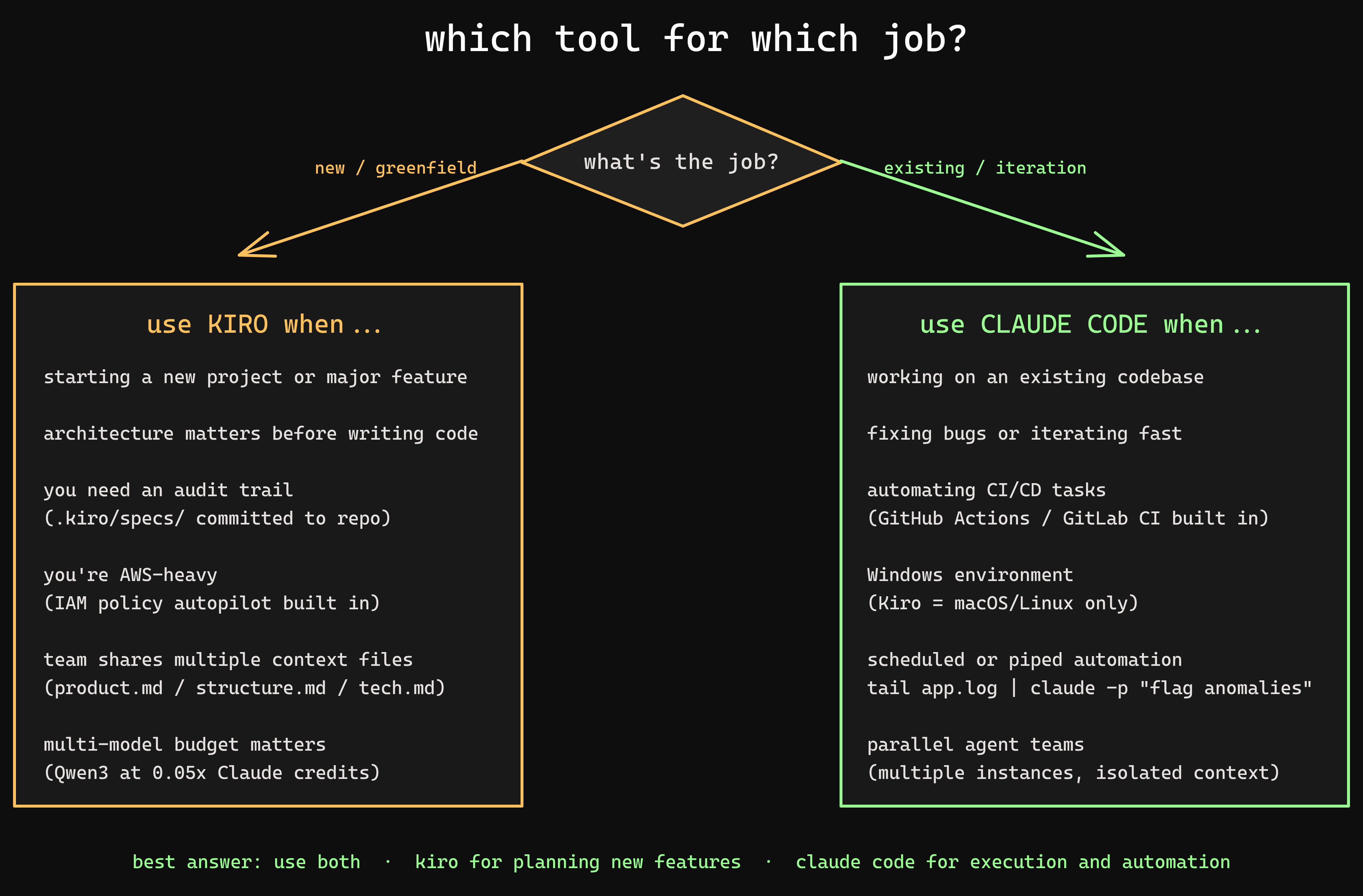
Use Kiro when starting a new project or major feature where getting the architecture right before writing code actually matters. The spec workflow adds friction for small changes, but for anything where you'd otherwise just start hacking and figure it out later, that friction is the point. Also the obvious choice if you're AWS-heavy.
Use Claude Code when working on an existing codebase, fixing bugs, iterating quickly, or automating repetitive tasks. Better fit for CI/CD pipelines, Windows environments, and anything where you need to move fast without ceremony.
Honestly, using both makes sense. Kiro for planning new features, Claude Code for execution and automation. They don't really compete for the same job.
Corrections to Other Articles
A few things circulating in comparison posts don't hold up against the official docs.
"Kiro runs agents sequentially": Several posts imply Kiro has no parallel execution. The official built-in tools docs list a use_subagent tool described as "spawns specialized subagents for parallel execution." Kiro doesn't have a user-facing Agent Teams API like Claude Code does, but parallel execution at the tool level exists.
"Kiro has no web search without MCP": Not mentioned in any comparison post I found, but the built-in tools docs show web_search and web_fetch as native tools. No MCP setup required.
Sources: Kiro CLI docs, Kiro built-in tools, Kiro model selection, Kiro pricing, Kiro spec docs, Claude Code docs