The first time I ran /superpowers:brainstorm, I expected Claude to start generating code. Instead it asked me four questions about what I was actually trying to build — not the technical details, the actual goal.
That was it. That was the shift.
Most people who use Claude Code treat it like a smarter autocomplete. You describe a function, it writes the function. Faster, but structurally the same job. You still hold the plan in your head.
The brainstorm command does something different. It backs the agent up before any code gets written and extracts the actual spec through conversation. Only then does it produce a plan — one concrete enough, as Jesse Vincent (the author of Superpowers) puts it, "for an enthusiastic junior engineer with poor taste and no project context to follow." Then it executes.
That's what agentic means in practice.
Three modes
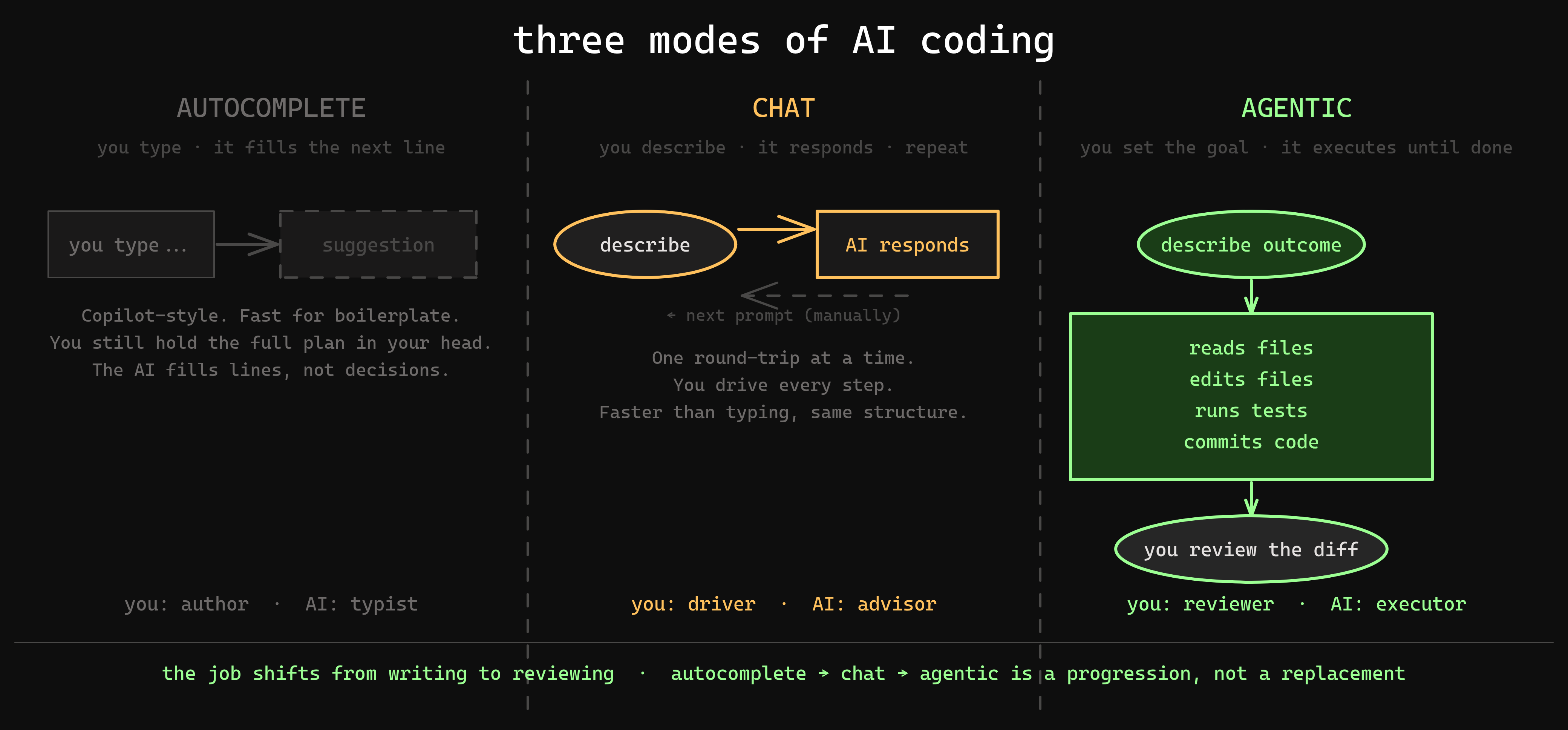
There are three ways to use an AI coding assistant.
The first is autocomplete — you type, it suggests the next line. Copilot-style. Fast, low-friction, low-trust.
The second is chat — you describe a problem, it responds. One round-trip at a time, still driven entirely by you.
The third is agentic. The model uses tools — reads files, runs tests, commits code, searches the web — and makes multi-step decisions until a goal is met. You don't press enter after every step. You describe an outcome, review what came back, and iterate from there.
The job shifts from writing to reviewing.
Superpowers
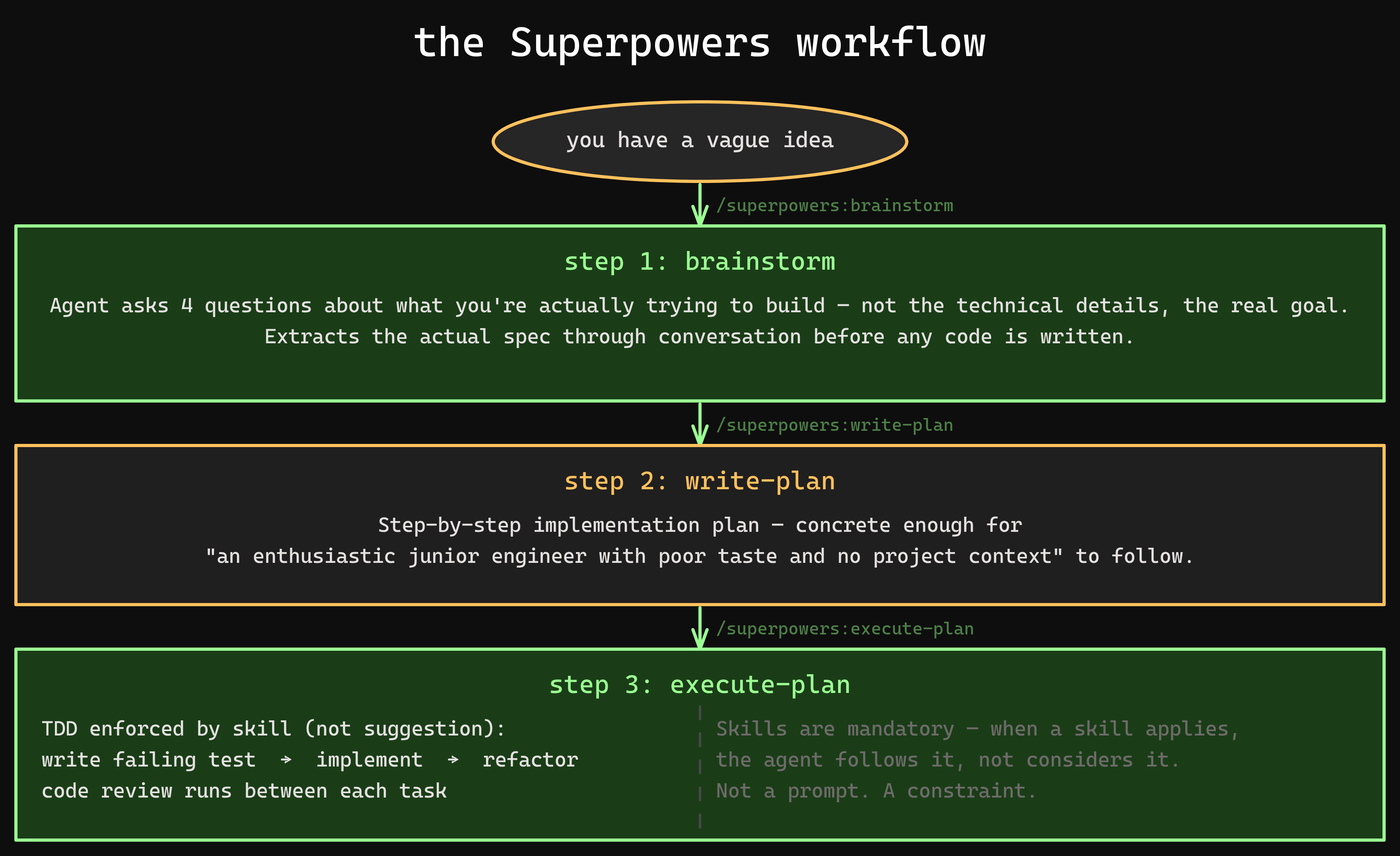
Superpowers is a skills framework for Claude Code built around that idea. Skills are SKILL.md files that teach Claude repeatable workflows. The difference from a regular system prompt: they're mandatory. When a skill applies, the agent follows it, not considers it.
The core workflow is three steps: brainstorm, write-plan, execute-plan.
Brainstorming extracts the real spec before anything gets built. Write-plan produces a step-by-step implementation spec. Execute-plan runs it — with a code review between each task.
Superpowers also enforces TDD via skill. The agent writes a failing test first, implements the minimum code to make it pass, then refactors. Not a suggestion buried in a prompt — a constraint the agent can't rationalize away.
Jesse Vincent published Superpowers in October 2025. By March 2026 it had 93,000 GitHub stars and was still gaining roughly 2,000 per day. That adoption rate says something about how many people found it solved a real problem, not a hypothetical one.
Everything Claude Code
Everything Claude Code (ECC) takes the approach further. Where Superpowers focuses on workflow methodology, ECC is an agent harness — the infrastructure around the agent that makes it reliable across sessions.
The key distinction ECC introduces: hooks vs skills. Skills execute probabilistically — the agent decides when they apply. Hooks execute deterministically, 100% of the time, at specific lifecycle events. A hook fires before every file write or at session end, regardless of what the agent decides in the moment.
ECC also has instincts: atomic learned behaviors with confidence scores that accumulate across sessions. The agent doesn't start from zero each time. It carries forward patterns from past work.
Built at a Cerebral Valley × Anthropic hackathon in February 2026, ECC includes a security scanner called AgentShield that checks your Claude Code configuration for exposed secrets, hook injection vectors, and permission misconfigurations.
Other tools worth knowing
If you're not tied to Claude Code specifically: Cursor and Windsurf are IDE-based with agentic modes built in. OpenCode and Aider are terminal-native like Claude Code and let you bring your own model. Superpowers works across several of these — not Claude Code-only.
The practical answer from teams who've tested multiple tools: use more than one. An IDE agent for daily work, a terminal agent for harder problems and automation pipelines.
The numbers and the panic
A METR study from 2025 found that experienced open-source developers using AI tools took 19% longer to complete tasks. Before starting, they predicted AI would make them 24% faster.
That gap between expectation and measurement is worth sitting with.
The Bloomberg "productivity panic" piece from February 2026 is real: companies are using agentic tools to ship faster and cut headcount. But the METR result suggests that reaching for the tool without changing the workflow doesn't help. The gains come from the structure, not the model.
You're probably not becoming obsolete. But someone who figures out how to delegate effectively to these tools — rather than just prompt faster — will cover ground you won't.
Where to start
Pick something you'd normally spend a day on but wouldn't lose sleep over if it went sideways. Install Superpowers. Run /superpowers:brainstorm before writing a single line.
The brainstorm step will feel slow. It isn't — you're just used to skipping it.