The 10x developer is supposed to ship ten times the code, work alone, and never break anything. That's the myth. None of it holds up.
The term has real origins. There are measurable productivity differences between developers on the same tasks. But what gets amplified in the retelling is almost always wrong: ten times the code, encyclopedic knowledge of every framework, a lone genius in a dark room. These make for a compelling archetype. They also describe a developer who would be exhausting to work with and quietly destructive to any team that believed in them.
What the term should mean is something more useful: a developer whose decisions make the people around them significantly more productive. Not ten times the output. Ten times the impact on the system.
what the term actually means
Being a 10x developer isn't about writing more code. It's about delivering more impact. These developers amplify their teams' effectiveness by optimizing workflows, automating repetitive tasks, and making decisions that improve long-term productivity. They don't just solve problems, they prevent them, streamline processes, and help their teams work smarter.
The shift in framing matters. A developer who writes 10x the code is a bottleneck waiting to happen, with all the knowledge concentrated in one person and no documentation or handoff. A developer who makes their team 10x more effective is the opposite: knowledge distributed, processes improved, problems solved once rather than repeatedly.
the myths
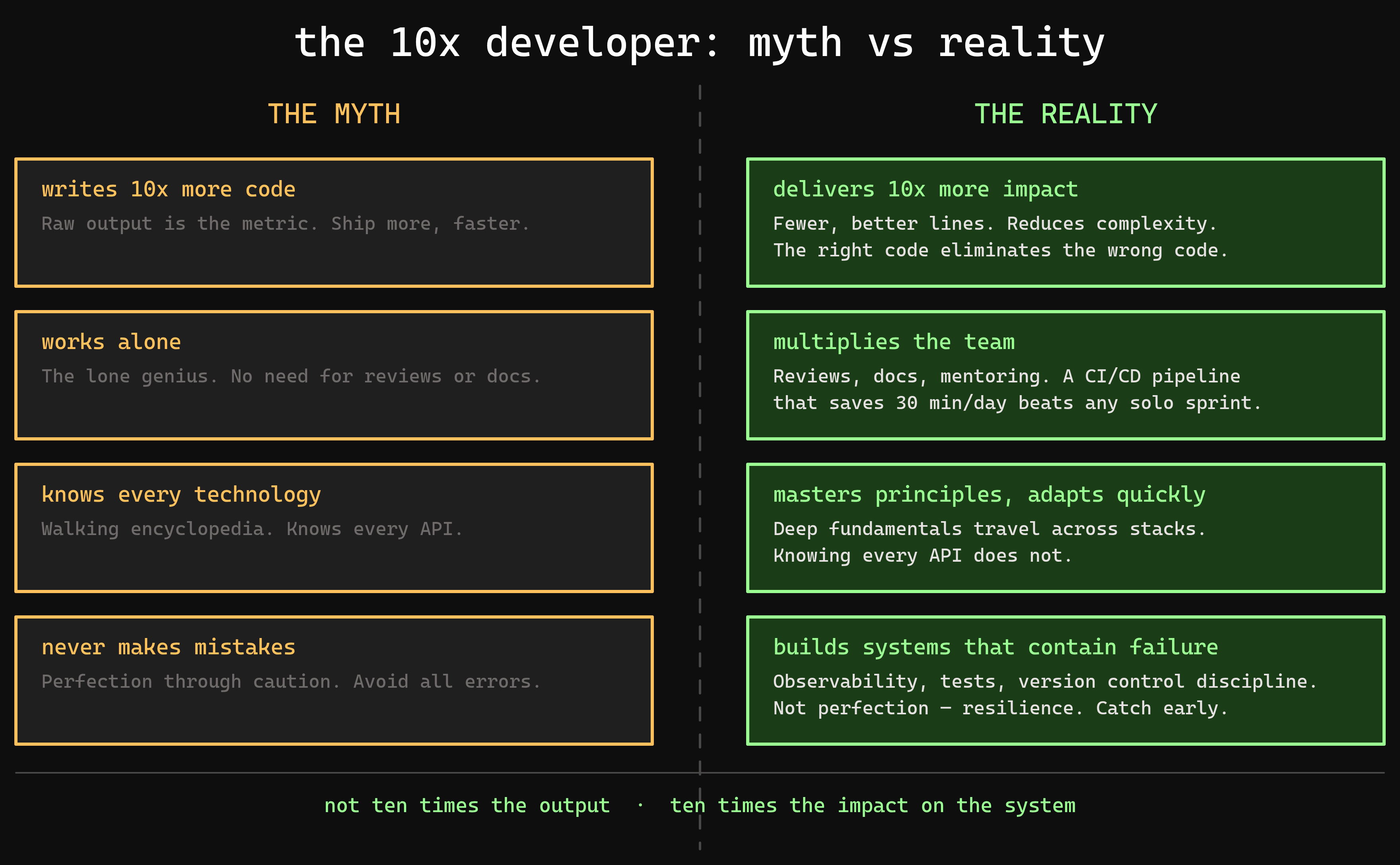
They write 10x more code. Software development isn't about quantity. A well-designed system can eliminate the need for unnecessary code altogether. Writing fewer, more efficient lines that improve maintainability and performance is more valuable than increasing raw output. A high-impact developer prioritizes clean, scalable, reusable code that reduces complexity, not code that adds to it.
They work alone. This one aggravates me. Anyone who has been part of a development team knows that collaboration and communication are central to how good software gets built. The lone wolf stereotype is almost exactly backwards: the most effective developers invest in documentation, code reviews, and tools that raise the productivity of everyone around them. Setting up a CI/CD pipeline that saves the whole team thirty minutes a day is worth more than any individual coding session.
They know everything about every technology. High-impact developers are not walking encyclopedias. They excel at knowing how to learn efficiently and when to apply their knowledge. They focus on core principles like design patterns, scalability, and problem decomposition, which lets them adapt quickly to new technologies. Deep understanding of fundamentals travels across stacks. Knowing every API does not.
They never make mistakes. Even the best developers make mistakes. What separates them is how those mistakes are handled. A high-impact developer doesn't try to avoid errors at all costs. They build systems that detect and contain them early. Observability tools, automated tests, version control discipline: the goal is not perfection but resilience. Quick iteration, problems caught before they compound.
what actually defines a high-impact developer
If raw output and lone heroics are the wrong metrics, here's what the right ones look like.
High-impact thinking. They don't optimize for busyness. They identify the work that has lasting effect: fixing the class of bug rather than the instance, refactoring the system that's generating toil, automating the deployment process that costs the team two hours every sprint. Strategic decisions that save time across the board.
Automation. A high-impact developer solves problems once. They build the internal tool, streamline the pipeline, automate the repetitive task. Removing friction for an entire team consistently outweighs any individual contribution.
Communication. Technical skill matters, but it's not enough on its own. A high-impact developer documents processes, gives substantive code reviews, and mentors junior developers. Their ability to articulate ideas clearly, in meetings, in documentation, in a Slack message at the right moment, prevents confusion and accelerates decisions. Knowledge that lives only in one person's head is a liability.
Root-cause thinking. They don't patch surface-level issues. They ask why the bug is happening, how to prevent the same class of problem in future, whether the architecture that produced it needs rethinking. The goal isn't a fast fix. It's ensuring the problem doesn't come back.
Adaptability. The tech landscape changes, and high-impact developers change with it, but not by chasing every trend. They evaluate new frameworks and methodologies critically, adopt them when they provide clear advantages, and build their understanding on fundamentals that stay relevant across stacks.
this is part one
Becoming a high-impact developer isn't a single step. It's an ongoing process of growth, deliberate practice, and strategic thinking. Over the next few posts in this series, we'll work through each of these qualities in detail: high-impact thinking, automation, communication, problem-solving, and adaptability.
The goal isn't to become a lone genius who outships everyone. The goal is to be the developer who makes your whole team faster.